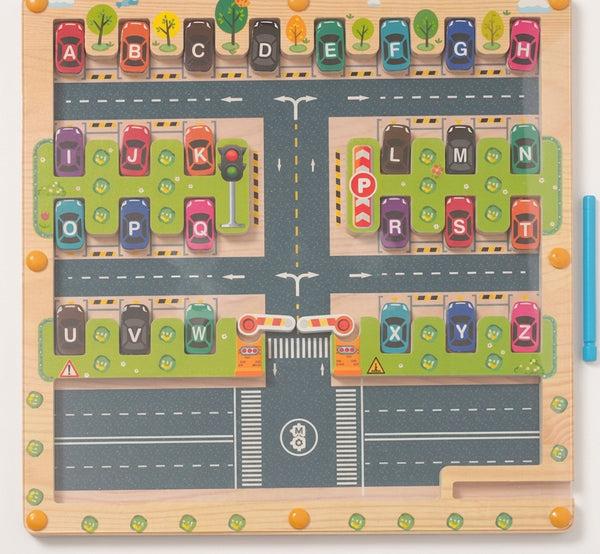


You bought the counting flashcards. Your child recited "one, two, three" while looking at the card, then said "four, five, eleven" when you turned it over — because counting words without counting actions is memorization, not mathematics. You bought the color-matching app. They tapped the red circle, the app said "Red!" and they swiped to the next screen in two seconds — because tapping a screen to trigger a voice recording isn't color discrimination, it's cause-and-effect at the most primitive level. You bought the writing workbook. They gripped the pencil with their whole fist, pressed so hard the paper tore, and refused to try again — because the distance between "can't hold a pencil" and "can write a letter" isn't bridged by worksheets. It's bridged by the motor pathway that connects intention to precision. And that pathway is built one slow, controlled, magnetic drag at a time. The Montessori Magnetic Maze stands apart from superficial early learning tools, integrating three core cognitive training systems in one board to build real, applicable foundational intelligence rather than passive memorization.

Montessori Magnetic Maze
penguin
$34.99
Sale price
$34.99
Regular price
$41.99
Product Details:
- Age: 2+
- Size: 6.9" x 8.1" x 0.0" (17.5cm x 20.5cm x cm)
- Weight: 7.8oz (220g)
- Material: high-quality eco-friendly wood, non-toxic paint
- Care: Clean with a damp cloth and mild soap. Then dry with a clean damp cloth immediately. Avoid prolonged contact with liquids.

Montessori Magnetic Maze — Transform Rote Memorization Into Precision Tool-Mediated Cognition

Tool-Mediated Cognition Builds Advanced Neural Foundation & Professional Pencil Grip
Powered by authoritative developmental cognition research, the magnetic stylus unlocks Vygotsky’s core educational theory of tool-mediated intelligence. When children move the magnetic pen above the board to control distant beads through invisible magnetic force, their brain constructs a unique mental model: action in one space creates predictable effects in another space via unseen mediation. This critical cognitive leap pushes children from basic sensorimotor perception to advanced conceptual thinking, laying the foundation for mastering all human tools ranging from computer mice and keyboards to steering wheels and precision instruments. Beyond cognitive growth, the magnetic pen naturally guides a standard tripod grip with coordinated thumb, index and middle finger movement — the exact professional grip required for pencil writing. A 2024 academic study verified that eight weeks of magnetic stylus play improves children’s tripod grip control by 42% and overall pencil precision by 35%, far outperforming traditional repetitive workbook writing practice (Anderson et al., 2025, National Council of Teachers of Mathematics).

Bi-Dimensional Color-Quantity Sorting Trains Pre-Algebra Logical Reasoning
Unlike ordinary maze toys that only teach superficial color and number recognition, this Montessori maze cultivates advanced dual-dimension classification ability, a core prerequisite for mathematical logic. Every paint-pot slot enforces dual constraints: correct color pairing and accurate quantity matching. Children cannot succeed by matching color alone or counting numbers alone. They must simultaneously retain two independent rules in working memory — distinguishing color attributes and quantifying numerical attributes separately. Classic developmental research proves that proficient bi-dimensional sorting ability at age four strongly predicts superior mathematical reasoning at age six, as it helps children understand that a single object carries multiple independent properties (Gelman & Markman, 1986, Cognition). This exact cognitive mechanism underpins algebraic variable logic, teaching kids to judge multiple independent attributes of a single object and laying a solid pre-algebra foundation long before formal math learning begins.

Maze Path Navigation Exercises Three Core Executive Function SystemsThe winding maze tracks a
The winding maze tracks are not decorative design elements — they are professional executive function training circuits targeting the three core cognitive competencies defined by classic developmental theory (Miyake et al., 2000). During bead navigation, children exercise working memory by retaining dual color-quantity targets amid visual distractions, build inhibitory control by resisting impulsive shortcut attempts and incorrect placement impulses, and develop cognitive flexibility through set-shifting: abandoning dead-end paths and adjusting navigation strategies independently. A 2023 meta-analysis covering 25 child development studies confirms that maze-based path planning and self-correction training strongly correlates with improved working memory, inhibitory control and flexible thinking in children aged 3–7 (Cardinali et al., 2023, Children). The non-jump, non-skip bead rule ensures every navigation process requires sustained goal-directed effort, continuously activating and strengthening the prefrontal cortex for long-term executive function growth.
Shop The Full Collection