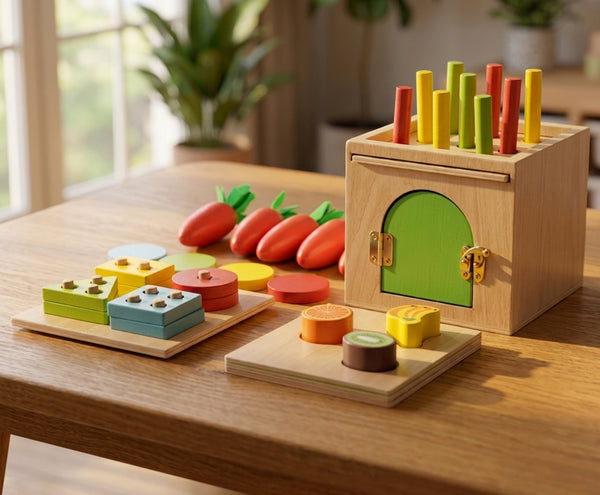


Every sorting toy on the market asks your child to do one thing: match the piece to the hole. Red circle goes in the red hole. Triangle goes in the triangle slot. One rule, one answer, one correct placement. That's classification — and it matters. But it's only half the skill. The Montessori Sorting Puzzle asks something no single-rule sorter can: the same piece must be sorted two different ways. The red triangle belongs with the reds when you sort by color. The same red triangle belongs with the triangles when you sort by shape. Same object, two categories, two correct answers — and your child must decide which rule is active right now. This is categorical flexibility, the foundational cognitive skill that moves children beyond rigid one-to-one matching toward flexible, abstract thinking.

Montessori Sorting Puzzle
$38.99
Sale price
$38.99
Regular price
$49.99
Product Details:
- Age: 3+
- Contains: (7) puzzle pieces, (25) double-sided cards, (1) storage box
- Size: 6.9" x 4.9" x 1.2" (17.5cm x 12.5cm x 3cm)
- Weight: 10.1oz (285g)
- Material: eco-friendly high-quality wood, non-toxic card paper
- Care: Clean with a damp cloth and mild soap. Then dry with a clean damp cloth immediately. Avoid prolonged contact with liquids. Cards - Spot clean only with a damp cloth.

Montessori Dual-Rule Sorting Puzzle — Master Categorical Flexibility Beyond Single-Rule Matching Play

Dual-Dimension Color & Shape Sorting Builds Core Abstract Reasoning Foundation
Ordinary sorting toys train only static classification, teaching toddlers that every object has one fixed attribute and one fixed matching result. This dual-rule sorting puzzle completely breaks fixed cognitive mindset by integrating two independent classification dimensions: color and shape. Every chunky wooden piece carries dual valid attributes, enabling two entirely reasonable sorting logics. Children learn that a single object does not have a fixed "correct home"; its classification depends entirely on the active judging rule. This subtle yet profound cognitive training helps toddlers gradually understand attribute abstraction, multi-angle observation and flexible classification, marking the critical transition from concrete visual matching to early abstract reasoning.

Evidence-Based Categorical Flexibility Determines Multi-Step Classroom Instruction Comprehension
Research shows that categorical flexibility is the key cognitive skill that distinguishes children who can accurately follow multi-step classroom instructions from those who struggle with rule switching and task adaptation (Carlson, 2005, Journal of Experimental Child Psychology). Preschoolers trained only on single-rule sorting tend to form rigid thinking habits, unable to abandon existing strategies and switch logic flexibly. In contrast, children who practice dual-rule sorting continuously exercise cognitive set-shifting: suppressing successfully applied old rules, activating new thinking frameworks, and reorganizing classification logic. This repeated mental switching perfectly simulates the frequent rule transitions required in formal learning — switching from addition to subtraction, spelling to grammar, or different task standards — building irreplaceable executive function advantages for classroom learning.

Premium Safe Wooden Construction Delivers Pure Screen-Free Executive Function Training
Crafted from high-quality solid wood with non-toxic water-based paint and smooth rounded edges, all chunky pieces are perfectly sized for toddlers’ small hands for safe grasping, placing and re-sorting. The polished burr-free surface ensures long-term repeated disassembly and reorganization without wear. No batteries, no screens, no sounds, and no electronic overstimulation. This pure child-led Montessori play avoids passive mechanical drills, focusing on training core early executive functions including rule switching, cognitive flexibility and multi-dimensional reasoning. It turns basic sorting play into advanced cognitive training, teaching children that true problem-solving ability lies in flexible rule judgment rather than fixed mechanical matching.

Intentional Reset Gameplay Triggers Effective Cognitive Restructuring & Strategy Adaptation
The Montessori Dual-Rule Sorting Puzzle features a scientifically designed two-stage play mechanism that maximizes cognitive growth. The wooden board supports precise shape slotting for initial layout completion, guiding children to finish standard geometric matching and consolidate basic spatial cognition. Once the shape sorting is completed, switching to color-family reorganization forces active mental reset. Children must voluntarily dismantle the finished correct layout, abandon the effective shape-matching strategy they just mastered, and reclassify all pieces purely by color tone. This deliberate "undo and restart" gameplay delivers high-value cognitive restructuring training, cultivating children’s flexible adjustment ability, anti-rigid thinking and proactive problem-solving awareness.
Shop The Full Collection